

Bitcoin is the first widely adopted cryptocurrency. Others came before it though. And before those cryptocurrencies, the same people who developed them were inventing free and open software.
Before that… they were building the internet itself.
In the 1980s and 1990s, a collection of people who would come to be known as “cypherpunks” laid the foundation for bitcoin.
These were mathematicians, technologists, entrepreneurs, and computer programmers who were dead set on creating technology in a way that empowered the individual.
Bitcoin is a way to hold, send, or receive value, privately, over the internet. As the internet was coming into being, cypherpunks were searching for ways to interact privately online. They were looking to push the internet in a direction where web browsers, software, and e-commerce sites weren’t built to spy on its users.
In their minds, the internet was to be a two-way street. It would be a place where the individual user could reveal his or her personal information selectively.
To understand bitcoin, you first have to understand the history of the internet. After all, bitcoin is just an application and network that leverages the internet in order to operate. It was dreamt up and further developed by many of the same cypherpunks who first championed the fight for digital privacy.
Cypherpunks
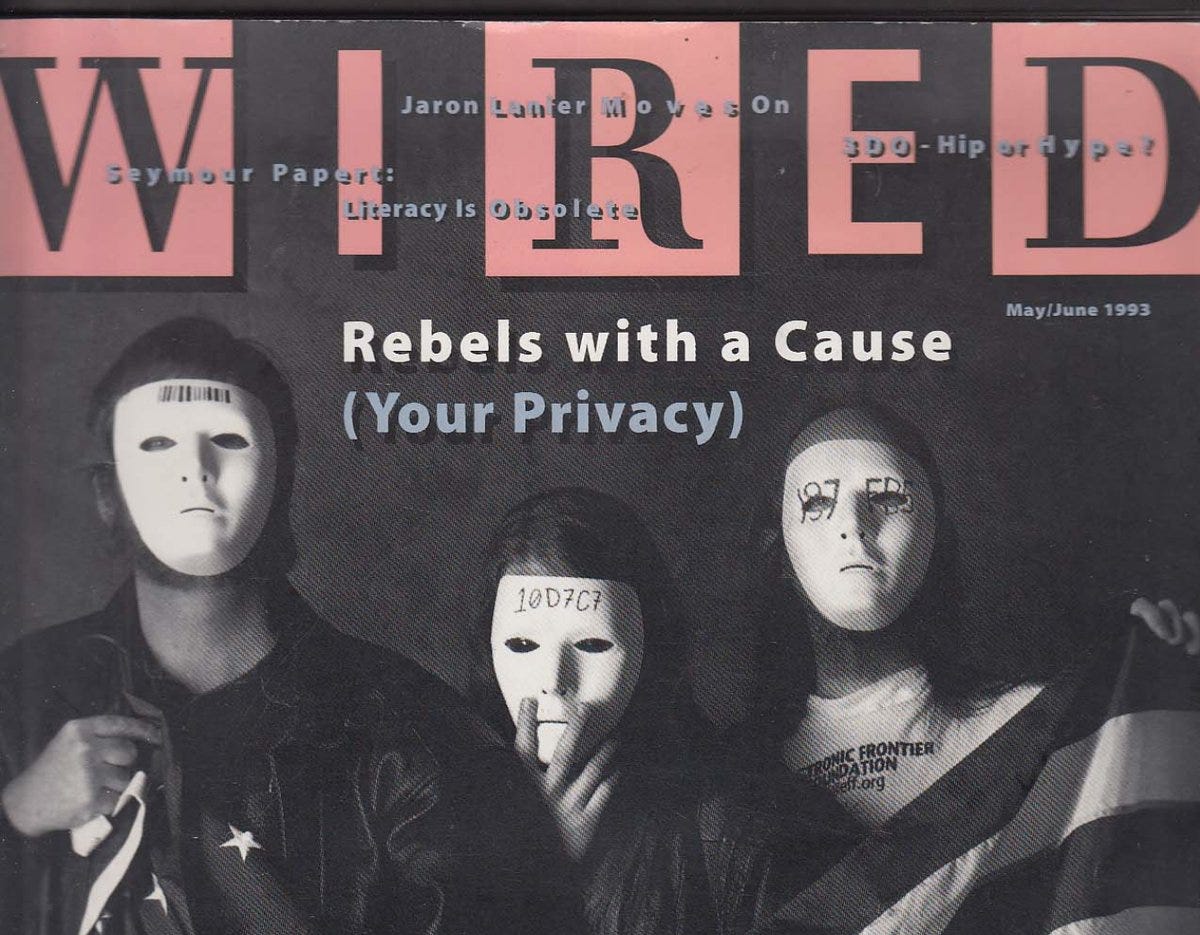
“We the Cypherpunks are dedicated to building anonymous systems. We are defending our privacy with cryptography, with anonymous mail forwarding systems, with digital signatures, and with electronic money.”
— Eric Hughes, March 9, 1993
Eric Hughes was concerned with privacy.
Everyone on the “Cypherpunks Mailing List” was either concerned with or at least interested in discussing topics of privacy, government oversight, and corporate control over information.
If Hal Finney (see this post for more on Hal) was one version of a cypherpunk, there were seemingly infinite other versions, each with their own ideologies.
Hughes was another version and he wasn’t alone.
In 1991, the world wide web launched.

With the advent of the world wide web, people everywhere could now connect with one another online. They could send messages and create web pages about anything they desired. It wasn’t until three to four years after the world wide web became publicly available though that the information age really took off. But, when it did, there was no stopping it.
The technology was something from the pages of science fiction books. It found use cases for both the individual and the state.
The idea of a global surveillance state was now very much a real possibility. To the cypherpunks, this was something urgent that needed to be addressed.
Individuals needed a way to combat the coming takeover of governments and enterprises in the new online arena.
Cypherpunks were well-versed in cryptography.
Many of them were cryptographers.
Others were computer scientists, mathematicians, and technologists. To the cypherpunks, cryptography represented a way to democratize privacy online. It was a tool that could be used to defend privacy and enable an open internet.
Cryptography is a way to secure communication using code. The technology hides a message or other data within a transaction from an outside observer. “Encryption” is the method by which this process occurs. Therefore, to “decrypt” or decipher a private message between two users would be to reveal that message or data to a third party.
Cryptography wasn’t just a tool that the cypherpunks were interested in defending though. Governments and militaries also recognized the need to uphold privacy when it came to many of their online communications and databases.
The world was expanding via the internet but it was also getting smaller and more connected. Doors that didn’t otherwise exist were now revealed and people on either side of the doorways were scrambling to find ways to keep those doors locked.
1st “Crypto” Meetups

Along with Hughes, John Gilmore and Timothy May started a meetup in San Francisco in 1992 to discuss cryptography as a tool for freedom.
The meetup pre-dated their soon to be “Cypherpunk Mailing List” they would launch later that year. The trend of meetups continues in cryptocurrency to this day. It’s not uncommon to find bitcoin or crypto meetups in major cities and even smaller towns or locales. While discussions about crypto are flourishing online today, there remains a desire to keep some conversations offline.
Plus, meetups are a simple way to encourage learning and build community even when it comes to topics that deal almost entirely in online interactions. After all, real live humans are the ones participating in the online space.
The cypherpunk mailing list began to grow. It would become the same place where Satoshi Nakamoto would first introduce bitcoin to the world 16 years later.
A Cypherpunk’s Manifesto
One year after the meetups and mailing list kicked off, Hughes put together a mission statement for the cypherpunks in a one-page essay entitled, “A Cypherpunk’s Manifesto.”
In the world of computer science, code is law. That sentiment rang true to the cypherpunks. In his manifesto, Hughes asserts that “Cypherpunks write code.”
Code is the foundational element of cryptocurrencies, blockchain technology, and any of the early software Hughes and others were concerned about.
“We know that someone has to write software to defend privacy, and since we can’t get privacy unless we all do, we’re going to write it. We publish our code so that our fellow Cypherpunks may practice and play with it. Our code is free for all to use, worldwide. We don’t much care if you don’t approve of the software we write. We know that software can’t be destroyed and that a widely dispersed system can’t be shut down.”
Hughes was talking about true, open-source, global software that could empower the individual user in the upcoming battle for online privacy.
The cypherpunks were thinking about use cases for online messages and electronic money. No longer was electronic cash or instant and private messing just theoretical considerations for future societies, the likes of which science fiction authors such as Neal Stephenson would popularize. These topics were happening in the here and now and couldn’t be stopped.
When it came to electronic cash, the new online frontier was either going to be dominated by the legacy banking and governmental systems or the cypherpunks were going to provide an alternative for the world to use; a way to opt out and defend individual privacy while doing so.
The early 1990s saw a flurry of activity stemming from the cypherpunks.
New to Bitcoin Binge?
Phil Salin
A budding economist with an interest in space was starting to experiment with these ideas discussed in Hughes’ manifesto.
Phil Salin was an entrepreneur in the privatization of outer space. He was proposing a way by which space travel could be done cheaper and more efficiently than the government. Salin, an economist and technologist with academic leanings toward Friedrich Hayek, saw opportunity everywhere with new advancements in technology.

In the 1980s, he founded a company called American Information Exchange (AMIX) which sought to facilitate a network of buying and selling information, goods, and services. AMIX was ahead of its time, maybe by only a matter of a few years.
Salin saw the potential of connectivity and AMIX would ultimately become a precursor to the likes of eBay and Amazon. In 1991, Salin spoke directly to the ethos of free and open software expressed by Hughes in the cypherpunk manifesto. John Gilmore, one of the originators of the San Francisco cryptographer meetup, had the following to say about Salin’s essay entitled “Freedom of Speech in Software.”
“Phil Salin opposed software patents on free speech grounds, claiming a government monopoly over the use of certain ideas in software was exactly equivalent to censorship of literary ideas. This was the first application of the concept of freedom of speech to software.”
Salin saw the coming centralized juggernaut that the cypherpunks were up against. There wasn’t just centralization in who controlled the internet, but there was also centralization in the control and flow of ideas.
If ideas weren’t allowed to flourish, then code and software would suffer. In turn, the future of a free and open internet was in jeopardy.
Salin saw a potential influx of patents on software and ideas as a major hurdle the cypherpunks needed to overcome. To Salin, the internet resembled what he saw in outer space. It was a new frontier that could forever change the landscape of human behavior. The internet represented possibility and he wanted nothing more than to reduce the friction surrounding a consumer’s activity online.
Turning online transactions and behaviors into something accessible, cheap, and efficient was the goal and Salin saw centralization and an attempt to stifle free and open software standing in the way.
Unlike many of his peers, Salin wouldn’t live to see the full extent of the internet. In late 1991, he passed away from complications due to liver cancer.
His wife, Gale Pergamit, noted that people weren’t ready for the ideas they were proposing. Salin was nothing if not an entrepreneur and, like most entrepreneurs, they tend to exist on the cutting edge, somewhere with one foot in the future.
Privacy
Accessibility and efficiency were key to the rapidly developing tech landscape, but so was privacy. It was the foundational concern for the cypherpunks.
Hughes and the cypherpunks believed that privacy was a human right.
Privacy was a prerequisite for a free and open internet. The opening lines of “A Cypherpunk’s Manifesto” read as follows.
“Privacy is necessary for an open society in the electronic age. Privacy is not secrecy. A private matter is something one doesn’t want the whole world to know, but a secret matter is something one doesn’t want anybody to know. Privacy is the power to selectively reveal oneself to the world.”
Without true privacy, the internet could be co opted by the corporations and governments that controlled the world prior to it.
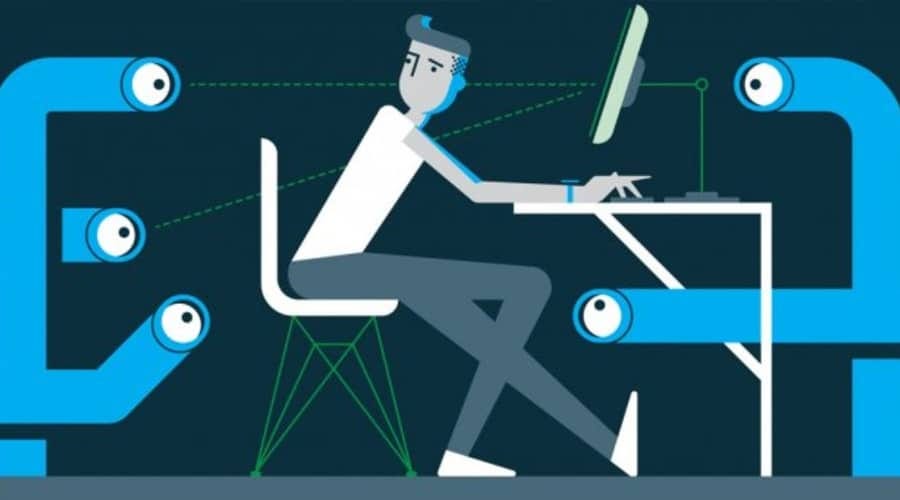
Like it or not, these authorities would establish a strong foothold in the new online space regardless of what the cypherpunks could accomplish but they had to do their part. A new battleground was forming around what would be referred to as “The Crypto Wars” and the cypherpunks were frontline soldiers…
Today, the story continues with bitcoin and all other technological innovations!
The original cypherpunks inspired generations of bitcoiners and innovators alike who are still building tools to protect privacy and rights online.
Thanks for reading!
If you have questions, drop a comment below or connect on Instagram.
I am not an investment or financial advisor. All opinions expressed are mine alone. Read the full DISCLAIMER on the About page.
HODL on Garth.
“Privacy is necessary for an open society in the electronic age. Privacy is not secrecy. A private matter is something one doesn’t want the whole world to know, but a secret matter is something one doesn’t want anybody to know. Privacy is the power to selectively reveal oneself to the world.”
So powerful message!