

Turbulent Times
Happy Bitcoin Friday! — Jan. 30, 2026

Turbulent Times
Bitcoin has a way of testing conviction not at the lows, but in the chop.
Zoom out far enough and the past two years make sense. Zoom in too close and everything feels uncertain. That tension, between structure and noise, is where long-term bitcoiners live.
If we’re anchoring ourselves to the familiar four-year halving cycle, the most recent bull market has likely already come and gone.
Bitcoin reached its all-time high near $126,000, almost exactly 18 months after the April 2024 halving. Historically, that 12–18 month window is where the delayed supply shock tends to show up in price.
So in that sense, nothing unusual happened.
And yet—many expected more.
The Halving: Underestimated, Overestimated, and Misunderstood
Newcomers tend to underestimate the halving because they don’t really understand it. Long-term bitcoiners often overestimate it because they understand it too well.
The truth is somewhere in between.
Long-term holders don’t suddenly change their strategy because a halving happens. They were accumulating before it and they’ll keep accumulating after it. Meanwhile, many participants in the most recent cycle barely knew the halving existed at all.
This cycle was defined less by grassroots bitcoiners and more by Wall Street rails—ETFs, custodial products, and publicly traded companies like Strategy. The halving didn’t disappear, but it got buried under a mountain of industry noise.
And there’s a deeper reality here: the halving’s impact is weakening over time.
So… are market cycles dead?
Bitcoin is simply bigger now.
It takes more capital to move markets. Institutional exposure means bitcoin is increasingly influenced by macro forces (rates, liquidity, risk appetite) because it now sits alongside other assets in diversified portfolios.
We got the all-time high when history suggested we would.
We just didn’t get the magnitude that many bulls hoped for.
Are We in a Bear Market?
In many senses, yes.
Bitcoin is currently sitting just above $80,000, which marks the 2025 low so far. Yes, there was a brief dip toward $75,000 during the broader post–Liberation Day sell-off in early April 2025, but that move was short-lived. Price quickly recovered, went on to make new highs, and only later corrected back to current levels. That context matters.
I don’t base any strategy on technical analysis, but I do think it’s important to understand the broader narrative that markets are telling us.
If $80k represents the low of this year, and it has held through both euphoria and correction, then it’s a meaningful reference point, whether we like it or not.
Bitcoin’s Yearly Lows (Perspective Helps)
One of the simplest ways to regain perspective is to look at where bitcoin has actually bottomed each year:
2010: $0.05
2011: $0.25
2012: $3.77
2013: $11.59
2014: $289.30
2015: $171.51
2016: $354.91
2017: $755.76
2018: $3,191.30
2019: $3,391.02
2020: $4,106.98
2021: $28,722.76
2022: $15,599.05
2023: $16,521.23
2024: $38,521.89
2025: $74,436.68
The pattern isn’t smooth.
It never has been.
But the direction is unmistakable.
Cost Basis: Where the Weight of Capital Actually Sits
Price is emotional.
Cost basis is structural.
As of the end of Q4 2025, the average cost basis of all bitcoin in circulation sits around $56,137. In some sense, that number represents the aggregate conviction of everyone who holds BTC.
If you’re looking for a true long-term floor, that range, $55k–$60k, is a reasonable worst-case scenario in a deep bear market.
Now layer in the largest recurring buyers.
Strategy alone holds over 700,000 BTC, with an average purchase price around $76,000. That lines up closely with the recent $75k–$80k lows, suggesting this zone may be a more realistic short-term floor.
When buyers of that scale sit near breakeven, markets tend to notice.
ETFs: Sentiment in Real Time
It’s now been two years since U.S. spot bitcoin ETFs launched.
BlackRock’s IBIT, the largest of them, holds over 700,000 BTC and is up roughly 90% since inception. On the surface, that’s a wildly successful product.
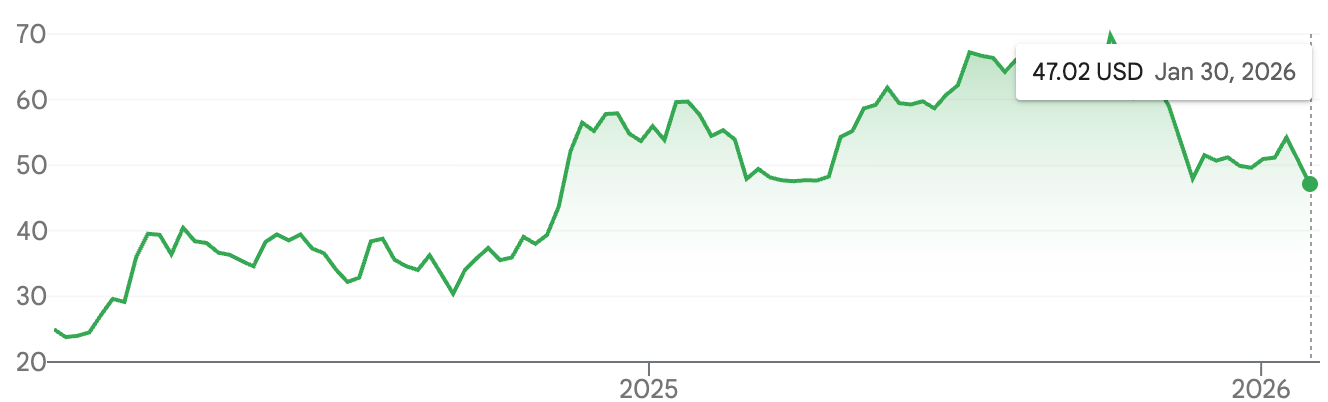
But zoom in again.
Across the major U.S. ETFs, the average investor cost basis is near breakeven. That’s notable. It means a huge cohort of traditional investors, many of whom are touching bitcoin for the first time, aren’t sitting on massive gains or losses.
From their perspective, bitcoin increasingly looks like a value decision, not a speculative one.
And that shift matters.

I got this chart from Ark Invest.
They do a Bitcoin Quarterly report.
It’s worth reading ^
The Bigger Realization
Writing this out makes something clear: bitcoin’s reach has quietly become enormous.
We now talk about it in the same breath as traditional financial markets, not as a novelty, but as something that belongs. And recent history is proving that it does.
That doesn’t mean volatility disappears.
It doesn’t mean cycles are 100% dead.
It doesn’t mean the path gets easier.
It means…
Discipline matters more than ever.
Turbulent times don’t invalidate the long-term thesis. They reveal who actually has one. Here’s to zooming out.
Enjoy the weekend!
Something else to read:
Bitcoin 101: Your Quick-Start Guide
Both AI and Bitcoin are among the most important long-duration technologies of the 21st century. Learn more about why that is.
Why Price, Hashrate, and Dominance matter more than anything else.
Is Bitcoin a hedge against inflation? What is a hedge? Find out more.
Is Bitcoin a new unit of account?
Hashrate is the true north of the Bitcoin network. Read this to learn about its role in Bitcoin’s health, security, and future.
Like what you’re reading?
I am not an investment or financial advisor. All opinions expressed are mine alone. Read the full DISCLAIMER on the About page.
HODL on Garth.