

Bitcoin: The Genesis Block
Price Action and Bitcoin History
Welcome to The Bitcoin Binge Letter!

Market Watch
Target Range: $38,000-43,000
Short Term: Consolidation
Long Term: Bullish
Bitcoin is eyeing $42,000. I’ve gone between being short term bearish or viewing the past several weeks as a consolidation period until bitcoin can retake $42k.
$30k long term support remains intact. Bitcoin has performed relatively well amidst ongoing geopolitical tensions resulting from the Russian invasion of Ukraine.
Note that I define “short term” as 0-3 months and “long term” as 3+ months. Traditional and crypto markets have seesawed in Q1 but the fact that bitcoin remains within striking distance of $42,000 leaves room for bullish optimism heading into the final weeks of the quarter.
Last week, I told paid subscribers that I want to see February close above the January close price point of $38,483.13.
Bitcoin is trading above $40,000 and is on track to hit my target price. Closing February above $38,000 opens up a possible move back to the mid $40,000s in March. Positive macro news could help boost bitcoin in the coming weeks.
This week, I want to place you in a specific moment in time in bitcoin’s history. Satoshi Nakamoto started the bitcoin network on January 3, 2009 by mining the first ever block of bitcoin. It’s known as “The Genesis Block.” The resulting bitcoin network was the culmination of hard work by both Satoshi and many others who came before him.
The Genesis Block
On October 31, 2008, a person by the name of Satoshi Nakamoto emailed a group of cryptographers with an idea for a peer-to-peer decentralized money. The money was called bitcoin. He gave a short pitch that included the following:
“The main properties: Double-spending is prevented with a peer-to-peer network. No mint or other trusted parties. Participants can be anonymous. New coins are made from Hashcash style proof-of-work. The proof-of-work for new coin generation also powers the network to prevent double-spending."
Double-spending is when you spend the same money twice. For example, if Bob gives Alice a twenty dollar bill, he can’t go spend that same twenty dollar bill himself. It’s Alice’s now. If he could spend it, it would be double-spent. When money is digital, it’s critical to prevent double-spending. With physical money, like paper currency, you have to produce a counterfeit version of that same twenty dollar bill in order to double-spend it. Doing so takes a lot of time and energy. With digital money, however, lines of code can be copied. What Satoshi describes uses a process called proof-of-work in order to make it difficult to copy the digital money. Proof-of-work is when computers solve complex mathematical problems and keep the network and its money in order.
The system Satoshi proposed was also peer-to-peer, meaning that any two individuals anywhere in the world could transact with each other using it. Plus, they could remain anonymous while doing so. All of this, he said, could happen without a central bank or other third party company like Visa or Mastercard. To the recipients of his email pitch though, bitcoin was a tough sell.
The email falls on relatively deaf ears for a few days before Satoshi receives mixed feedback. Those who do respond cite both the need for such a system but also question its feasibility. It's been tried before and it failed on several occasions. In his initial pitch, Satoshi mentions one of those failed experiments. It’s a precursor to bitcoin called Hashcash. Satoshi knows his audience. The group is familiar with Hashcash and other attempts at electronic money. He’s reaching out to them for a reason. It’s an elevator pitch to a group that’s been debating topics like this since the 1980s.
“Satoshi” is an alias or an online name chosen by the author of the email. It isn’t his real name. We never actually discover who Satoshi Nakamoto is in real life. Despite their best efforts, journalists and obsessed bitcoiners have not uncovered his true identity. Individuals pop up throughout the story of bitcoin claiming to be Satoshi but no legitimate claims are made.
Satoshi remains anonymous. He exists online for a period of time. He introduces bitcoin to the world, experiments with it in its infancy, and interacts with other developers. Those interactions are more business-like than not and he doesn’t offer much by way of personal information.
Based on one of his online profiles, we do know that he claimed to be a 37-year-old male living in Japan. The term “Satoshi” now extends beyond the name of bitcoin’s pseudonymous creator. In his honor, the smallest unit of bitcoin is called a “satoshi.” One single satoshi is like a penny to a dollar but in bitcoin, one satoshi represents one hundred millionth of a bitcoin.
Satoshi’s real world identity is never verified. We have no way of knowing whether or not what he claimed to be online was true. His proficient use of English has led many to believe he was in fact not Japanese and that he instead could have been British.
Satoshi’s identity, however, doesn’t matter in the story of bitcoin. It doesn’t matter to the functionality of bitcoin today. Throughout bitcoin’s early development, Satoshi was able to work on bitcoin while leaving his personal life out of it. His identity is left up to our imaginations. Satoshi existed, but now he is nothing more than a mythical figure. If he is alive, Satoshi wants to remain private. He would be one of the wealthiest persons on the planet. If he is no longer alive, bitcoin is his legacy.
Months after his initial pitch, Satoshi mined the first ever block of bitcoin. The initial block of bitcoin is called “The Genesis Block.” In bitcoin, a “block” is a set of transactions that are bundled together. After blocks are processed by bitcoin miners, they’re added to a public ledger called the “blockchain.”
Blocks are added in sequential order to build a history of activity on the bitcoin network. Anyone can see the transaction history on the blockchain. The overall history is public but details about each transaction’s buyer and seller remain private. Satoshi envisions bitcoin remaining that way, allowing participants to maintain some anonymity.
The Genesis Block was mined on January 3, 2009. It marked the official start of the bitcoin network. Despite a tepid reception from the cryptographer mailing list, Satoshi gets bitcoin up and running.
One week later, a software developer named Hal Finney sent the first ever Tweet about bitcoin. In it, he writes two words:
“Running bitcoin”

Finney was the first person other than Satoshi to run the bitcoin software. He was also on the receiving end of the first bitcoin transaction. Days after the bitcoin software was live, Satoshi sent Finney 10 bitcoin. The transaction was a way to test whether or not bitcoin worked. It did. In the days following the transaction, the two developers went back and forth over email discussing bugs and issues they found in the software. Then, they went about applying fixes.
As was true to Satoshi’s interactions with others, the conversations stuck to the business at hand. Finney recalls never questioning whether or not Satoshi was a young man of Japanese ancestry. Regardless of Satoshi’s true identity, Finney believed he was being genuine. He also attested to the bitcoin creator’s intelligence.
In a post made to an online forum, Finney wrote, “I thought I was dealing with a young man of Japanese ancestry who was very smart and sincere. I've had the good fortune to know many brilliant people over the course of my life, so I recognize the signs.” Finney would know. He was brilliant in his own right.
Prior to bitcoin, Finney was the second developer hired by accomplished computer scientist Phil Zimmermann at PGP Corporation. The company began after Zimmermann revolutionized the computing world years prior with the release of his software called Pretty Good Privacy (PGP). The computer software allowed individual users to encrypt the messages, emails, text files, and other communications they sent online using cryptography.
Today, PGP and other forms of encryption are used in the largest messaging platforms in the world. At the time of its release though, Zimmermann became an enemy of the state. He was enabling individual users to steer clear of the watchful eye of governments and corporations online.
The United States government viewed the software as an attack on national security. Zimmermann and his peers faced backlash but remained steadfast in their commitment to release the software. It was free and open-source and they intended to keep it that way. PGP used elements of public-key cryptography that Satoshi would eventually incorporate into bitcoin. The success of PGP proved that encryption via cryptography could be utilized within a real world application such as messaging. PGP scared governments everywhere. Accusations of individuals using the software to encrypt and send government secrets or plans for illicit activities to bad actors were hurled against Zimmermann. In the end though, the software developers won out.
After the government dropped its case against Zimmermann, he founded PGP Inc. It would later become PGP Corporation and Finney would make his mark on the digital world while working at the company.
In 2004, Finney developed a piece of software called Reusable Proof of Work (RPOW). The software was an evolution of the Hashcash-style protocol described in Satoshi’s bitcoin white paper.
In Hashcash, new coins created with proof of work could only be used once. They were not reusable. You spent the new coin and then it was gone. The creator of Hashcash, Adam Back, hadn’t yet solved the double-spend problem in cryptocurrency. In order to account for the problem of double-spending, all coins created were made not reusable. By destroying the coins after they were used, this prevented them from being copied and counterfeited. To spend more coins, you needed to create new ones.
At PGP Corporation, Finney had a breakthrough. He found a way to reform the proof of work software and make things reusable. He didn’t yet have a way to successfully apply it to a cryptocurrency though. When he read Satoshi’s email in 2008, Finney was floored. Years later, on March 19, 2013, Finney recapped his work on bitcoin in his final post to an online forum called BitcoinTalk, saying:
“...Fast forward to late 2008 and the announcement of Bitcoin. I've noticed that cryptographic graybeards (I was in my mid 50's) tend to get cynical. I was more idealistic; I have always loved crypto, the mystery and the paradox of it.
When Satoshi announced Bitcoin on the cryptography mailing list, he got a skeptical reception at best. Cryptographers have seen too many grand schemes by clueless noobs. They tend to have a knee jerk reaction.
I was more positive. I had long been interested in cryptographic payment schemes. Plus I was lucky enough to meet and extensively correspond with both Wei Dai and Nick Szabo, generally acknowledged to have created ideas that would be realized with Bitcoin. I had made an attempt to create my own proof of work based currency, called RPOW. So I found Bitcoin fascinating.”
Finney was well-accomplished in the business world of tech but he also embodied the spirit of the more subversive and altruistic side of something called “The Cypherpunk Movement.”
The cypherpunks were individuals, like Finney and Zimmermann, interested in advocating for use of cryptography and privacy practices in technology. Finney represented the type of person who could both contribute to and champion bitcoin. He was a cypherpunk but he was also practical and grounded. Finney was an avid runner with an excitement for life. He had a wife and children. He was an optimist. Bitcoin hooked him. It hit on something that he’d been interested in for years, taking ideas he’d developed to a whole new level.
Finney’s involvement in bitcoin, however, faded in 2009. Life took an unexpected turn for the accomplished cypherpunk and he stepped away from the bitcoin project.
In 2009, Finney announced he had been diagnosed with amyotrophic lateral sclerosis (ALS). As time passed, his body began to fail and his speech slurred. Finney’s strength deteriorated. Prior to his diagnosis, he’d been training for his first marathon. Over the years, he’d run half marathons and had taken a liking to distance running. Finney closed his final post to the BitcoinTalk Forum with details about his condition. He also mentioned his ability to still enjoy life. He’d still found ways to write code and he remained interested in bitcoin. Finney mentions his excitement around seeing the price of bitcoin go up and down.
“ALS is a disease that kills motor neurons, which carry signals from the brain to the muscles. It causes first weakness, then gradually increasing paralysis. It is usually fatal in 2 to 5 years. My symptoms were mild at first and I continued to work, but fatigue and voice problems forced me to retire in early 2011. Since then the disease has continued its inexorable progression.
Today, I am essentially paralyzed. I am fed through a tube, and my breathing is assisted through another tube. I operate the computer using a commercial eyetracker system. It also has a speech synthesizer, so this is my voice now. I spend all day in my power wheelchair. I worked up an interface using an arduino so that I can adjust my wheelchair's position using my eyes.
It has been an adjustment, but my life is not too bad. I can still read, listen to music, and watch TV and movies. I recently discovered that I can even write code. It's very slow, probably 50 times slower than I was before. But I still love programming and it gives me goals. Currently I'm working on something Mike Hearn suggested, using the security features of modern processors, designed to support "Trusted Computing", to harden Bitcoin wallets. It's almost ready to release. I just have to do the documentation.
And of course the price gyrations of bitcoins are entertaining to me. I have skin in the game. But I came by my bitcoins through luck, with little credit to me. I lived through the crash of 2011. So I've seen it before. Easy come, easy go.
That's my story. I'm pretty lucky overall. Even with the ALS, my life is very satisfying. But my life expectancy is limited. Those discussions about inheriting your bitcoins are of more than academic interest. My bitcoins are stored in our safe deposit box, and my son and daughter are tech savvy. I think they're safe enough. I'm comfortable with my legacy.”
Responses to his final post to the forum in 2013 were positive. Those who replied expressed gratitude for Finney’s work getting bitcoin off the ground. Readers congratulated him on a life well-lived.
In March 2013, Finney’s perspective was refreshing for bitcoin enthusiasts to see. It was a reminder of the good people who worked hard to create bitcoin.
By March 2013, the price of bitcoin was closing in on a then all-time high above $200. The struggling Mt. Gox bitcoin exchange in Tokyo, Japan was under pressure to keep up with demand and fend off regulators and hackers alike. Amidst the chaos, Finney came off of a breath of fresh air in the cryptocurrency space. Finney passed away the year following his final post to the BitcoinTalk Forum. Due to complications of ALS, he left the world on August 24, 2014.
Satoshi sent his initial email that Finney and others read on October 31, 2008. One month prior to the email, the world was in the throws of a crisis. On September 15, 2008, the 2007-2008 global financial crisis came to a head with the bankruptcy of Lehman Brothers. Satoshi didn’t live in a vacuum. He was well aware of what was happening in the world. When Satoshi mined the Genesis Block of bitcoin on January 3, 2009, he included an inscription that read:
"The Times 03/Jan/2009 Chancellor on brink of second bailout for banks."
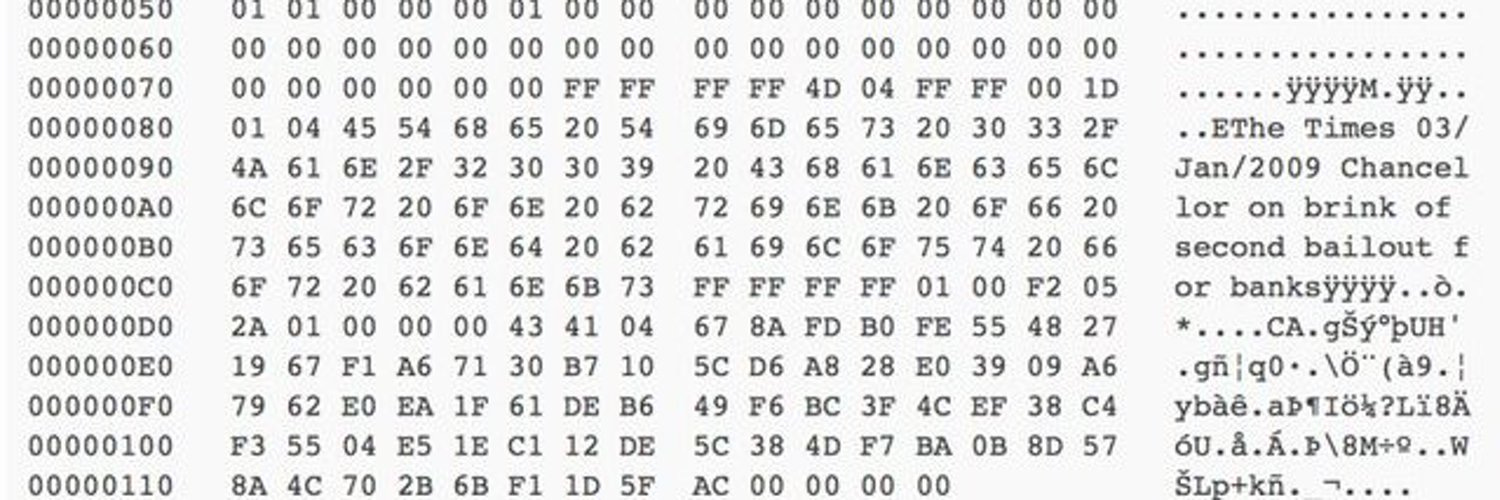
The inscription was included for two reasons. The first is that it referenced a headline in The Times, Britain’s oldest daily newspaper. It’s a timestamp to confirm when the bitcoin block was created.
The second reason the inscription is included is to give bitcoin a mission statement. The headline provides a kernel of insight into why Satoshi was working on bitcoin. He was living in the same world that everyone else was in 2007-2008, one in crisis. This is the world that helped inform bitcoin. The characteristics of bitcoin that Satoshi described were some that cypherpunks had been working toward for years. But, in 2008, those characteristics were more important than ever before.
If bitcoin solved the problems previously faced by earlier forms of digital money, it would change the world. Bitcoin could empower people everywhere with an alternative means to store wealth and transact outside of the traditional banking system. Bitcoin represented freedom from the watchful eye of the state. If it worked, the possibilities were endless.
Goodbye Ruble, Hello Bitcoin.